Temporary Roof Repair in Connecticut.
Tarping, Mitigation, Documentation.
Stop active damage while you wait for permanent repair or insurance sign-off. Heavy-duty tarping, photo documentation, written mitigation invoice for your claim.
Book emergency tarping →Lock your tarp slot
Stop the damage. Document it. Then deal with the rest.
Get Your Roof Quote
Replacement or repair · 60 seconds · No phone tag
What can we help with?
Licensed CT HIC.0703927 · Fully insured · No phone tag
When tarping makes sense
A temporary fix that earns its place.
Most homeowners we tarp are in one of three situations. A tree limb came through the roof last night and the rain is forecast to continue for another two days. A wind event lifted a large section of shingles and the insurance adjuster won't be out until next Tuesday. Or a permanent repair scope is bigger than a same-day job and the homeowner needs the roof watertight until the crew can return.
In all three cases, the right move is a properly installed temporary tarp. Not a homeowner-installed blue tarp from the hardware store flapping over the eaves — those last one storm at best. A professionally installed temporary uses heavy-duty woven polyethylene, sandwiched wood strips for fastening, and roofing screws driven into the deck. It holds for 60–90 days in CT weather, which is enough time to settle insurance and schedule permanent work.
Per the FEMA Operation Blue Roof program documentation, even federally installed disaster tarps are explicitly temporary — designed to last only as long as it takes to schedule permanent repair. The point is mitigation, not a long-term solution.
What you get
Documented mitigation, ready for your claim.
Every CT homeowners policy we've ever read has a clause requiring “reasonable action to prevent further damage” after a covered event. The clause cuts both ways — it's a requirement, and it's also a reimbursement mechanism. Reasonable mitigation expenses are part of the claim.
Our temporary tarp visit produces three things you can hand to your adjuster:
- Date-stamped photos of the damage before the tarp is installed, the tarp during installation, and the completed mitigation.
- A written scope note identifying the damage, the suspected cause (storm, wind, impact), and the mitigation method.
- A line-item invoice for the mitigation work, separate from any future permanent repair invoice.
Adjusters move faster on claims with this level of documentation because they don't have to guess what happened or when. We're not your insurance advocate — but we set you up to advocate for yourself effectively.
Safety reality
A few things we won't do.
We don't install temporary tarps in active storms. Sustained winds above roughly 25 mph mean a freshly installed tarp becomes a sail, and the safety risk to the crew is real. We assess, advise you on inside-the-house mitigation, and tarp at the first safe window. Sometimes that's the same day, sometimes it's the morning after the front passes.
We don't tarp by stapling sheets of plastic to shingles. That's a homeowner-style fix and it does more damage than good — every staple is a new hole. Proper temporary tarping spans the damaged area, gets weighted or fastened at the edges with wood strips and roofing screws, and is sized to overlap the next-up shingle course so water sheds correctly.
And we don't pretend temporary work is a long-term fix. A tarp is a clock — 60 to 90 days, after which the UV exposure starts breaking down the material and you have a different kind of leak. Permanent repair or replacement has to follow.
Pricing
Same published tiers.
Temporary tarping
$400–$600
Small repair tier — single slope, isolated damage area, photo-documented.
$800–$1,300
Big repair tier — multi-slope or large-area tarp coverage.
Invoice formatted for direct submission with your insurance claim.
FEMA tarping (when available)
Free
Operation Blue Roof only — federally declared disaster events.
Source: USACE Operation Blue Roof.
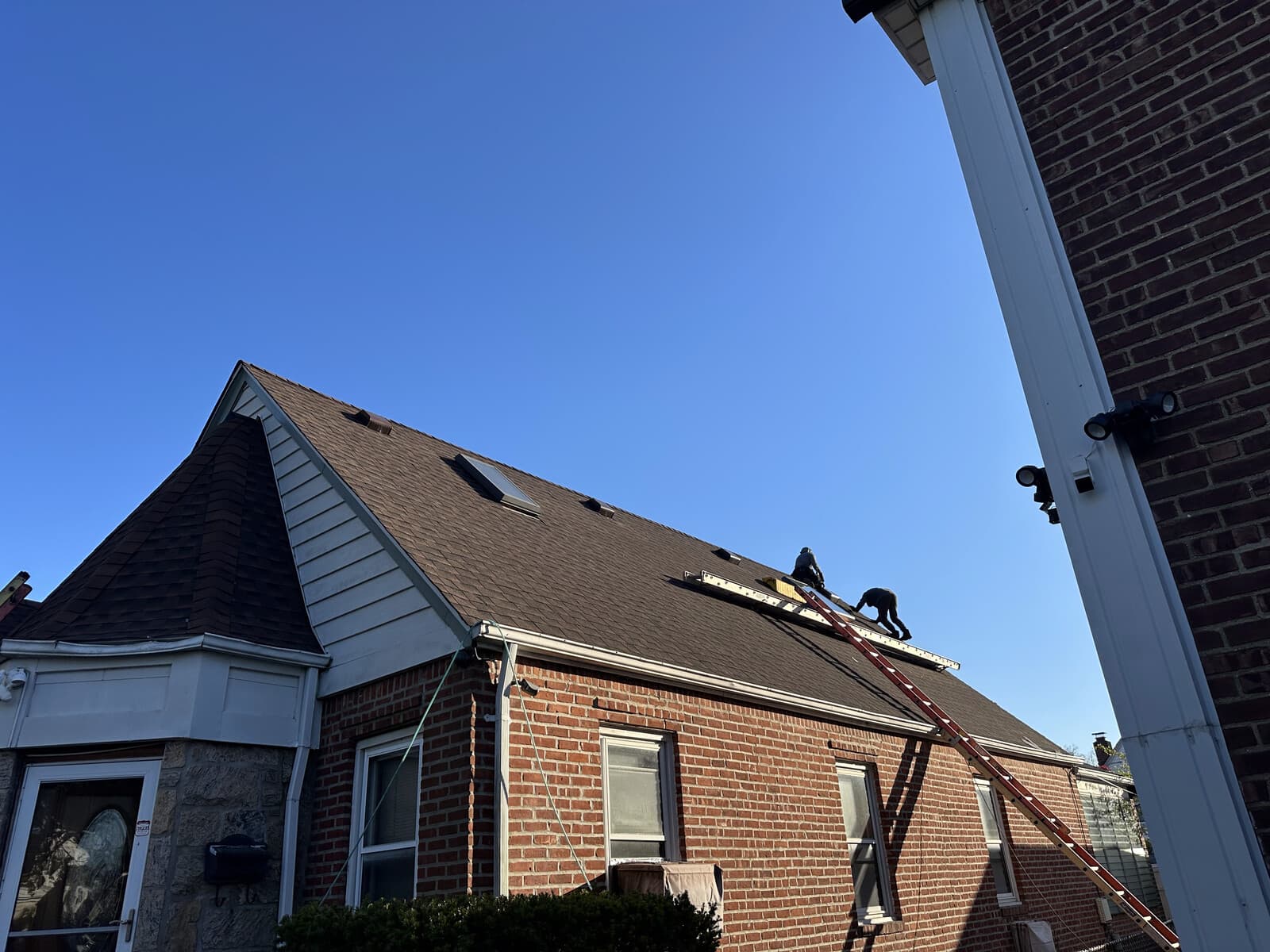
Mitigation in progress
CT residential — photo-documented for claim
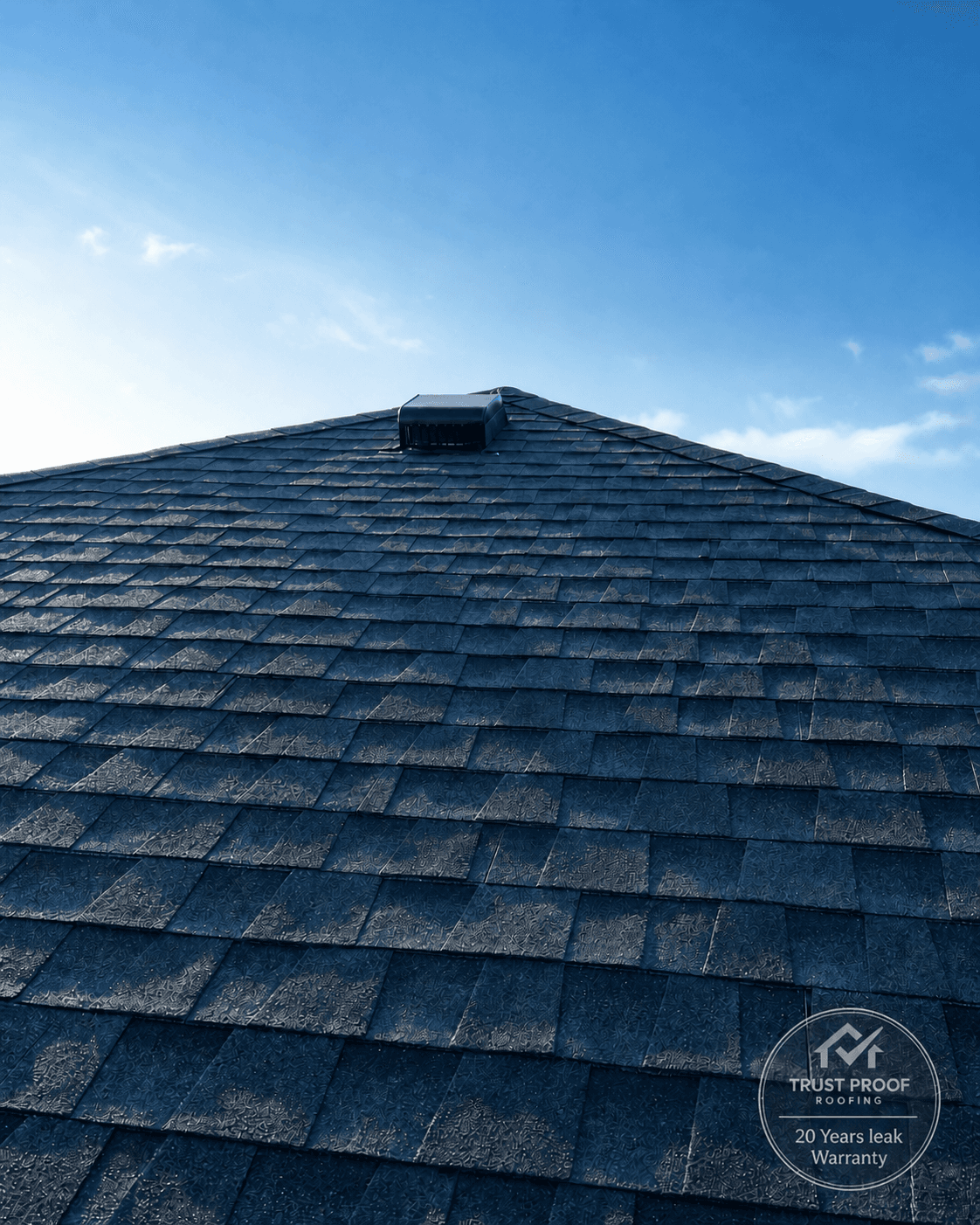
After permanent repair
The tarp's job ends; the warranty begins
Common questions
Temporary roof repair, answered.
When does a roof need a temporary repair or tarp?
After active wind, hail, or tree-impact damage when permanent repair has to wait — usually because the storm is still active, insurance is in process, or the scope is bigger than a same-day fix. Temporary repair stops further water entry, prevents interior damage from getting worse, and satisfies the "Duty to Mitigate" clause in most CT homeowners policies.
How long does a temporary roof tarp last?
A properly installed temporary tarp lasts 60–90 days in CT weather. Heavy-duty woven polyethylene tarps secured with sandwiched wood strips and roofing screws hold up through standard wind and rain events. UV degradation is the main failure mode — past 90 days the tarp itself starts breaking down. We size the temporary to the expected timeline for permanent repair.
Will insurance reimburse temporary roof repair costs?
Most CT homeowners policies have a "Duty to Mitigate" clause that requires you to take reasonable action to prevent further damage after a covered event — and that clause makes reasonable mitigation expenses reimbursable. Save the invoice. Document the damage before the tarp goes on (photos help). The adjuster will typically reimburse temporary repair costs as part of the overall claim settlement.
Can FEMA tarp my roof for free?
Only after a federally declared disaster. FEMA's Operation Blue Roof, run through the U.S. Army Corps of Engineers, provides free temporary tarping after large-scale disaster events — but most CT weather events do not qualify. The program also excludes slate, asbestos, and clay tile roofs. For typical CT storm damage, private temporary repair is the realistic option. See the official Operation Blue Roof page if you're uncertain whether your event qualifies.
How much does temporary roof repair cost in Connecticut?
Temporary tarping typically falls into our small-tier pricing of $400–$600 — labor, tarp material, secure attachment, and photo documentation included. Multi-slope or large-area tarping can move into the $800–$1,300 range. The temporary repair invoice is built so it can be submitted with your insurance claim as documented mitigation.
Can I tarp my own roof?
We strongly recommend you don't. Wet asphalt shingles are slick, CT roofs run 4/12 to 12/12 pitch, and ladder falls are the most common homeowner injury in storm response. If you must do something before professional help arrives, work from inside: bucket the drip, kill the breaker to the affected ceiling, move furniture. Stay off the roof.
How fast can you tarp my roof?
We schedule emergency tarping through the same intake form as any other repair — Monday through Saturday, four daily windows. In active storm aftermath we add capacity but lead times can stretch. Submit the form as early as you can; slot-locking is first-come.
What happens after the temporary repair?
Three paths. (1) Insurance is in motion — we wait for adjuster sign-off, then quote and execute permanent repair. (2) No insurance involved — we schedule permanent repair as soon as the homeowner is ready, often within a week or two. (3) Replacement scope — the temporary holds while we proceed to a full roof replacement quote. The tarp covers the gap; the written record of mitigation supports whichever path follows.
Storm damage in motion? Storm damage repair →
Active leak right now? Emergency roof repair →
Need full replacement instead? Roof replacement in CT →
Stop the damage. Schedule the tarp.
Mon–Sat windows, photo-documented, insurance-ready invoice.